Difficulty conceiving becomes a medical question when pregnancy has not occurred after the appropriate period of regular, unprotected intercourse, but certain warning signs justify earlier assessment. By understanding the evaluation, treatment sequence, likely trade-offs and questions to ask, you and your partner can choose the next step without treating fertility as one partner’s problem alone.
Key takeaways
- Seek evaluation after 12 months under age 35 or 6 months at age 35 and older.
- Both partners need evaluation because infertility causes can affect either person.
- Choose treatment after reviewing ovulation, sperm, fallopian-tube, and uterine findings.
- Ask about IVF success factors, risks, costs, alternatives, and the number of cycles planned.
When should a couple seek an infertility evaluation?
Infertility is failure to achieve pregnancy after 12 months of regular, unprotected intercourse when the woman is under 35. At age 35 or older, evaluation is recommended after 6 months after age 35 of trying. That is when to see a fertility specialist, unless a concern calls for earlier help.
Seek evaluation sooner if you have:
- Irregular or absent periods
- Suspected endometriosis or fallopian-tube disease
- A previous pelvic infection or pelvic surgery
- Recurrent miscarriage
- Known sperm problems
- Erectile or ejaculation difficulty
- Previous chemotherapy
Both partners should be assessed from the beginning, not one after the other. A male-factor issue contributes to roughly 40%–50% of infertility cases, either alone or alongside a female-factor issue, so semen analysis is an early test rather than a last resort.
The clinician will review reproductive history and select further testing according to your findings, which can include ovulation assessment, pelvic imaging and fallopian-tube evaluation. Earlier assessment can identify a time-sensitive problem and prevent months of treatment aimed at the wrong cause.
What tests identify the cause of infertility?
Start with the basics: review cycle dates, bleeding pattern, ovulation symptoms, pregnancy history, medications and medical conditions. Regular cycles often indicate ovulation, while irregular or absent periods prompt assessment for polycystic ovary syndrome (PCOS), thyroid disease or hyperprolactinemia.
A physical examination and pregnancy test exclude common explanations before more specialised testing; ovulation testing is added when cycle history is unclear.
A semen analysis assesses the male partner from the beginning. It measures semen volume, sperm concentration, motility and morphology. Follow the laboratory’s collection instructions, including the requested abstinence period and complete sample collection. Because results vary between samples, an abnormal result is commonly repeated rather than treated as a final diagnosis.
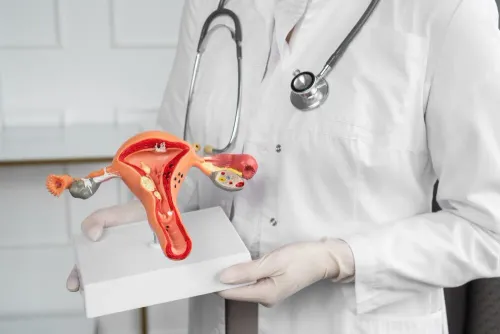
Pelvic ultrasound can assess the uterus, ovaries, endometrial lining and visible signs of fibroids or endometriosis. Hysterosalpingography uses X-ray contrast, while HyCoSy uses ultrasound contrast, to show whether the fallopian tubes are open. Neither test fully evaluates the uterine cavity: saline-infusion sonography or hysteroscopy investigates suspected polyps, fibroids or other cavity abnormalities.
- Ask whether you need an AMH test, antral follicle count or follicle-stimulating hormone as part of ovarian reserve assessment.
- Interpret these tests as estimates of response to ovarian stimulation, not guarantees of natural conception. Low AMH does not make pregnancy impossible, and normal AMH does not remove age-related egg-quality decline.
- Request a combined explanation of all findings; no single test identifies every cause of infertility.
How does the diagnosis determine the first treatment?
The diagnosis sets the treatment ladder. Doctors compare cycle regularity and ovulation, semen concentration and motility, tubal patency, pelvic imaging, uterine-cavity findings, endometriosis evidence, and ovarian-reserve results before escalating.
| Finding | What identifies it | Treatment that fits first |
|---|---|---|
| Ovulation disorder | Irregular cycles, absent ovulation, PCOS, thyroid or prolactin abnormality | Treat the cause; use ovulation induction |
| Tubal disease or endometriosis | Hysterosalpingography, HyCoSy, surgery or imaging | IVF when tubes are blocked; selected endometriosis cases need IVF |
| Uterine condition | Ultrasound, saline-infusion sonography or hysteroscopy | Remove or treat a polyp, fibroid or cavity abnormality |
| Diminished ovarian response | AMH, antral follicle count and follicle-stimulating hormone | Discuss prompt, individualized treatment, often IVF |
| Male-factor infertility | Abnormal semen concentration, motility or morphology | Repeat and manage the result; consider IUI or IVF based on severity |
| Unexplained infertility | Normal standard testing in both partners | Timed intercourse, IUI or IVF based on age and available time |
Timed intercourse suits couples with ovulation, usable sperm and open tubes. For anovulatory infertility caused by PCOS, with no other infertility factor, letrozole is the preferred first-line medicine; exclude pregnancy, adjust the dose and monitor response. Ovulation medicines encourage egg release but do not open blocked tubes or overcome severe sperm-production problems.
IUI versus IVF depends on diagnosis, age, ovarian response and total motile sperm count. IUI places prepared sperm in the uterus around ovulation, but blocked tubes and severe sperm-production problems make it unsuitable. IVF becomes more relevant with those findings, diminished ovarian response, failed selected IUI cycles or limited time because of age.
What should couples know before choosing IVF?
IVF is a process, not a guaranteed live birth. Compare IVF success rates only when the figures match your age at egg retrieval, diagnosis, ovarian response, embryo stage, and fresh or frozen transfer.
| Figure reported | What it counts | Question to ask |
|---|---|---|
| Per retrieval | Outcomes from one egg-collection cycle | Does this include every embryo created from that retrieval? |
| Per transfer | Outcome after one fresh or frozen embryo transfer | Is the rate live birth, clinical pregnancy, or pregnancy test? |
| Cumulative | Outcomes across transfers from one retrieval | Over what period, and are frozen transfers included? |
Ask for age-specific live-birth rates, not a clinic-wide headline percentage. A single embryo transfer reduces twin or higher-order pregnancy risks; transferring multiple embryos raises the chances of preterm birth and neonatal morbidity.
PGT-A does not guarantee a healthy baby or improve live-birth rates for every patient. Its value depends on age, the number of embryos, and miscarriage history. Biopsy results can be mosaic or inconclusive, leaving decisions about transfer uncertain.
Discuss ovarian hyperstimulation syndrome, blood clots, and ovarian torsion before stimulation. An antagonist protocol, GnRH-agonist trigger, and freeze-all strategy can reduce OHSS risk when appropriate. Seek urgent medical advice for severe abdominal swelling, persistent vomiting, shortness of breath, or reduced urination after treatment.
How can you make a treatment plan you can live with?
A livable plan balances medical benefit against fertility treatment costs, time, emotional strain and risk. Do not choose IVF automatically if timed intercourse or IUI fits the diagnosis, age, ovarian response and available time.
Fertility declines as egg number and chromosomal normality change; egg freezing preserves eggs at the freezing age, but mature-egg numbers, thawing, fertilisation and embryo development still determine outcomes, so it cannot guarantee a future live birth.
Questions to ask a fertility clinic include:
- What are the risks of ectopic pregnancy, miscarriage and multiple pregnancy?
- What medication side effects require urgent advice?
- What will happen to unused embryos, and what storage or consent decisions apply?
- When will we review the plan, and what result will trigger a change?
| Option | Main trade-off | Review point |
|---|---|---|
| Timed intercourse or IUI | Lower intervention, but less useful with blocked tubes or severe sperm problems | After the agreed number of cycles |
| IVF | Greater potential benefit, cost, medication burden and procedural risk | After each retrieval or transfer |
| Egg freezing | Preserves eggs at today’s age without promising a later birth | When deciding whether and when to use them |
Stop smoking, limit excessive alcohol and avoid recreational drugs. Supplements, special diets, acupuncture and commercial IVF add-ons do not restore age-related egg quality or reliably replace proven care.
Fertility counselling can help with difficult choices. In Pune, Dr Manisha Patil's Heal & Care - 08048073856 can review both partners’ findings, compare intensity with your budget and timeline, and identify genuinely needed tests or referrals.
Related service
Gynecology & Women's Health Best Infertility Treatment Clinic in NIBM Road, Pune If you are looking for infertility treatment in Pune, Dr. Manisha Patil’s Heal & Care Clinic provides personalized gynecology and fertility care for... View service → |
Frequently asked questions
When should a couple seek an infertility evaluation?
Seek evaluation after 12 months of regular, unprotected intercourse when the woman is under 35, or after 6 months when she is 35 or older. Seek help sooner for irregular or absent periods, suspected endometriosis, previous pelvic surgery, recurrent miscarriage, testicular problems, or known fertility concerns.
What tests identify the cause of infertility?
Evaluation commonly includes a medical and menstrual history, ovulation assessment, pelvic ultrasound, ovarian-reserve testing when appropriate, fallopian-tube testing such as hysterosalpingography, and semen analysis. Doctors select tests according to each partner’s history rather than ordering every test for everyone.
How does the diagnosis determine the first treatment?
Treatment depends on the cause, age, duration of infertility, test results, and pregnancy goals. Options can include timed intercourse, ovulation-induction medicine, treatment for endometriosis or fibroids, intrauterine insemination, or IVF.
What should couples know before choosing IVF?
Before IVF, discuss the expected benefit, medication schedule, egg retrieval, embryo transfer, risks, total cost, alternatives, embryo-storage decisions, and what happens if the first cycle does not work.
How can you make a treatment plan you can live with?
Set priorities with your clinician, agree on a budget and time limit, understand each step and decision point, plan emotional and practical support, and decide in advance when you will pause, change treatment, or stop.