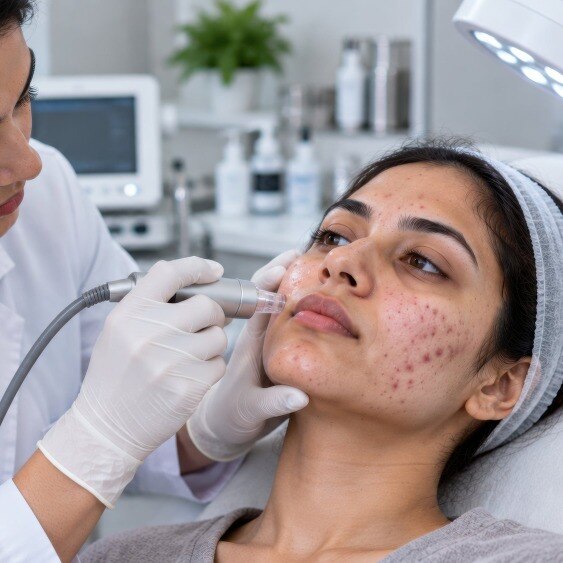
A flat red or brown patch after a pimple needs a different approach from an ice-pick scar, a rolling depression or a raised keloid. By separating active acne from lasting texture changes, you can choose a safer sequence of home care, prescription treatment and procedures instead of treating every mark as a scar.
Key takeaways
- Flat colour changes are marks; dents, pits, or raised tissue are true scars.
- Start with a gentle routine before adding procedures or stronger acne treatments.
- Match treatment to scar type: ice-pick, rolling, boxcar, or raised.
- Check active acne, skin sensitivity, medications, and healing risks before procedures.
Is it active acne, a post-acne mark or a true scar?
A flat colour change is not the same problem as a change in skin texture. Identify what you see before choosing treatment.
| Finding | What it usually means | What to look for |
|---|---|---|
| Active acne | Blackheads, whiteheads or inflamed pimples | A plugged pore, redness, swelling or pus |
| Post-inflammatory erythema | A temporary post-acne mark | A flat red, pink or purple area |
| Post-inflammatory hyperpigmentation | A temporary post-acne mark | A flat brown or gray area |
| Atrophic acne scars | A structural depression | Ice-pick, rolling or boxcar indentations |
| Raised scar | Excess scar tissue | A firm hypertrophic scar or keloid rising above the skin |
Post-inflammatory erythema and post-inflammatory hyperpigmentation often fade gradually. Atrophic acne scars create shadows because tissue is missing or tethered; their size and types determine whether procedures are useful. Raised hypertrophic scars and keloids need a different plan, because resurfacing for pits can aggravate them.
Acne severity changes the next step. Occasional comedones may improve with a consistent topical routine, while widespread inflammatory acne, painful nodules, body acne or lesions that are leaving new scars need clinician assessment. Do not squeeze deep spots; they can scar even without picking.
Control new breakouts before considering scar procedures. Ongoing inflammation can create more scars and obscure whether treatment has worked, so calm active acne first, then reassess colour changes and texture.
What first-line routine controls pimples without creating more irritation?
Control active acne before treating scars: each new inflamed lesion can add discoloration or scarring, while procedures cannot stop new breakouts.
- Morning: wash with a gentle cleanser, apply a non-comedogenic moisturiser, and finish with broad-spectrum sunscreen. After cleansing, use clinician-directed treatment as instructed. Benzoyl peroxide reduces acne-causing bacteria and inflammation; a topical retinoid unclogs pores, treats comedones and helps prevent new lesions; azelaic acid can improve both acne and discoloration.
- Introduce one active ingredient at a time. Start benzoyl peroxide or a topical retinoid on alternate days or fewer nights, then increase as your skin tolerates it. Dryness or stinging can occur early; moisturise, and reduce frequency if irritation becomes persistent, swollen or painful.
- Use an antibiotic only under supervision and never alone. Combining it with benzoyl peroxide or another non-antibiotic treatment helps limit antibiotic resistance. Review oral antibiotics at about 12 weeks rather than continuing them indefinitely.
- Do not combine several irritating products immediately. Avoid picking or squeezing, and never attempt home extraction, especially for deep, painful nodules.
For selected women with hormonal acne that follows the menstrual cycle or affects the jawline, a clinician may discuss combined oral contraceptives or spironolactone. Spironolactone is not used during pregnancy. Isotretinoin is reserved for severe, scarring or treatment-resistant acne and requires strict pregnancy avoidance and safety monitoring; discuss pregnancy plans before starting it.
Which treatment matches ice-pick, rolling, boxcar and raised scars?
Match the procedure to the scar’s structure, not to the treatment with the most dramatic name. A shallow depression needs a different approach from a deep, narrow pit or a scar tethered below the skin.
| Scar type | Procedures considered | Key limitation |
|---|---|---|
| Shallow atrophic scars | A chemical peel for acne scars or microneedling; fractional laser resurfacing | Improvement depends on depth, skin tone and healing response. Laser settings and downtime require careful planning. |
| Rolling scars | Subcision for rolling scars; microneedling, laser or fillers after assessment | Subcision releases bands pulling the skin downward. Fillers suit selected depressions, not every scar. |
| Ice-pick scars | Punch excision, punch elevation or focal chemical reconstruction | Narrow, deep ice-pick scars often need focal treatment rather than broad resurfacing. |
| Boxcar scars | Fractional laser resurfacing, microneedling, punch techniques, subcision or a combination | Boxcar scars vary by depth and edge sharpness, so one procedure may not fit all. |
| Raised scars | Steroid injections and other flattening treatments | Hypertrophic scars and keloids are not pits. Resurfacing can worsen the problem, and recurrence remains possible. |
Most scar treatments provide partial improvement over multiple sessions, not a complete return to unscarred skin. A clinician also weighs skin tone, active acne, healing history, pain tolerance and available downtime before combining procedures. Control new inflammatory acne first; otherwise fresh scars can appear while you are judging the older ones.
What must be checked before a peel, laser, microneedling or injection?
A safe acne scar consultation starts with your medical and skin history, not a device choice. Tell the clinician about current medicines and skincare, pregnancy or breastfeeding, skin sensitivity, recent tanning, previous procedures, and any current or previous isotretinoin use.
Report cold sores before laser, and mention any keloid risk or scars that grew beyond an injury.
Medium-to-dark skin tones need particular care. Inflammation, some laser settings and stronger peel settings can trigger post-inflammatory hyperpigmentation, so stronger treatment is not automatically better.
Ask these questions before agreeing:
- Which exact scar type is being treated: ice-pick, rolling, boxcar, raised scar, or only a flat mark?
- What device, needle depth, injection product, or peel strength will you use, and why does it suit my skin type and post-inflammatory hyperpigmentation risk?
- How many sessions are expected, how far apart will they be, and what downtime should I plan for?
- What pain control, cleansing, moisturising and sunscreen routine will I follow afterward?
- What should I do if pigment changes, swelling, infection or an acne flare develops?
A clinician should decide treatment timing and settings for your history rather than apply universal waiting periods. In Pune, Dr Manisha Patil's Heal & Care - 08048073856 can be considered for an assessment linking active-acne control with cosmetic planning before procedure safety is assumed.
How do you know whether the treatment plan is working?
Judge acne treatment progress by what changes, not by one dramatic photograph. Fewer new inflamed lesions show better acne control; fading red or brown colour shows improvement in post-inflammatory marks; smoother shadows or shallower depressions show a response to scar treatment.
- Take before-and-after photographs every four weeks in the same lighting, from the same angle and at the same distance. Keep a simple record of each product, missed applications, dryness, burning, swelling and other irritation.
- Continue broad-spectrum sunscreen every morning, including after acne treatment and resurfacing. Ultraviolet and visible light can darken post-inflammatory hyperpigmentation, while sunscreen helps protect the healing skin barrier.
- Attend an acne review appointment before adding another active ingredient or procedure. A treatment that causes persistent burning, swelling or painful cracking needs adjustment rather than another product layered on top.
- Seek prompt professional care for painful nodules, rapidly worsening acne, extensive body involvement, suspected infection, severe medication reactions or new scarring.
Do not judge a scar procedure while fresh redness or swelling is still changing. Reassess marks after active acne settles, because continued breakouts can create new scars and hide scar treatment results.
Follow the staged sequence: calm active acne, protect the skin barrier, reassess marks, then select one or more scar treatments based on scar type, skin tone, downtime tolerance and realistic improvement goals.
Frequently asked questions
How can you tell an acne mark from a true scar?
A flat red, brown, or grey area is a post-acne mark. A depression, pit, tethered texture, or raised area indicates a true scar.
What first-line routine helps control pimples without worsening irritation?
Use a gentle cleanser, non-comedogenic moisturiser, daily broad-spectrum sunscreen, and one acne treatment introduced gradually rather than several irritating products at once.
Which treatments match different acne-scar types?
Ice-pick, rolling, boxcar, and raised scars need different approaches. A clinician must examine the scar’s depth, edges, tethering, and height before selecting treatment.
What should be checked before acne-scar procedures?
Check for active acne, sensitive or inflamed skin, recent tanning, medicines, a history of raised scars, and conditions that affect healing before a peel, laser, microneedling, or injection.
How do you know whether an acne treatment plan is working?
Track new pimples, inflammation, darkening, irritation, and scar texture with photos taken in consistent lighting. Reassess when progress stalls or side effects increase.